Complaint Sites vs. the Law: What Actually Gets a False Review Removed
Drash Eldetron
Writes about digital privacy, reputation, and online presence.
September 3, 2026
The reason a complaint site can shrug off a removal request comes down to nine words in federal law: no provider of an interactive computer service shall be treated as the publisher of what someone else posted on it.
That single rule explains almost everything about how these sites behave — including why some of the most-repeated advice about getting a complaint removed simply isn't true. This post covers what the law actually protects, what one site's real, documented refusal policy looks like up close, and the narrow set of things that genuinely work instead.
Quick overview
- Complaint sites are protected by Section 230 — they generally aren’t liable for user posts, so nothing legally forces them to remove one just because it’s disputed.
- Ripoff Report has a documented refusal policy, and courts have confirmed it isn’t bound by injunctions against the original poster.
- Other sites handle this differently — but none of them simply delete a post on request either.
- What actually works is narrow: a court judgment naming the specific false statements, then requesting deindexing.
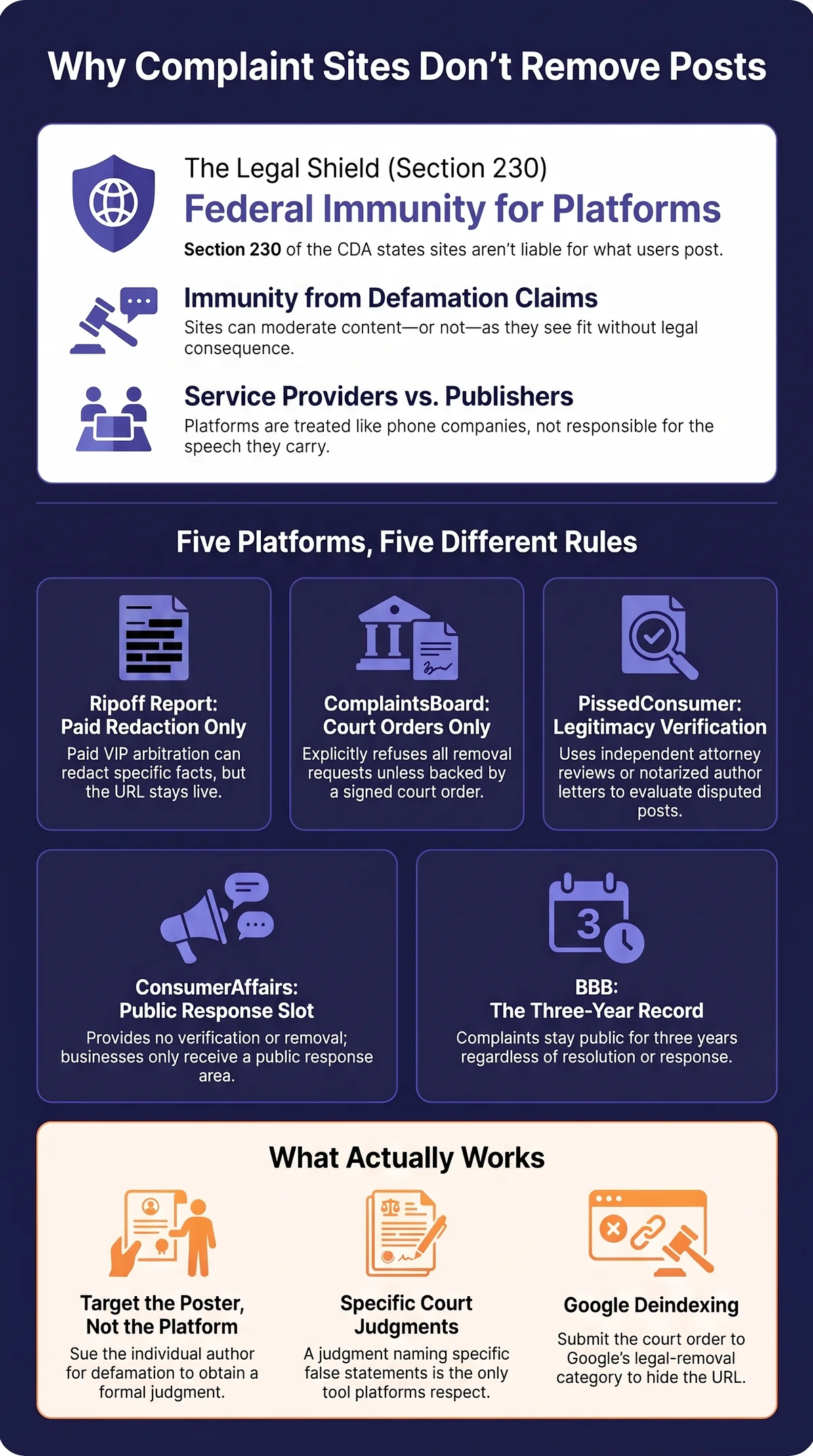
The Legal Shield: Why Complaint Sites Don’t Have to Listen
Section 230 of the Communications Decency Act says that “no provider or user of an interactive computer service shall be treated as the publisher or speaker of any information provided by another information content provider.” In plain terms: the site hosting a complaint generally isn’t legally responsible for what a user wrote in it, the same way a phone company isn’t responsible for what’s said in a call it carries.
A related provision, § 230(e)(3), bars state-law claims that would conflict with that immunity — which is why filing a state defamation claim against the site itself usually goes nowhere, even when the underlying post is genuinely false.
As EFF’s plain-language explainer puts it, the law lets a platform moderate — or not moderate — content “as they see fit.” That’s a policy choice sitting entirely with the platform, not something a disputing business or individual can force through a takedown request. Complaint sites like these also generally don’t verify who’s posting the way a transactional review platform might — see our guide to how verification actually differs by platform category for that contrast.
For the practical side of dealing with this across review platforms generally, see our review removal guide.
Ripoff Report’s Documented Refusal Policy
No site illustrates this more directly than Ripoff Report, which states outright on its own site that it has “a long-standing general policy to not remove posts.” That’s not just a stated policy — it’s held up in court.
In Blockowicz v. Williams (7th Cir. 2010), a plaintiff had already won a default judgment ordering the original poster to take down their reports; when that poster couldn’t be found, the plaintiff asked Xcentric, Ripoff Report’s operator, to comply instead.
The Seventh Circuit refused to bind Xcentric, since it hadn’t been a party to the original case and “mere inactivity is simply inadequate” to treat it as acting “in active concert or participation” with the poster. It’s worth being precise about what that case actually shows: it’s not that a court ordered Ripoff Report to remove content and it defied the order — it’s that Ripoff Report was never bound by an order aimed at someone else in the first place.
That refusal isn’t quite absolute, though. Ripoff Report runs a paid VIP Arbitration Program, starting at $2,000, where an independent arbitrator can find a specific factual statement false — but even a win there only redacts that one statement; the report itself and its URL stay live.
It’s Not Just Ripoff Report
Every major complaint site draws this line somewhere slightly different, but none of them simply delete a post because a business disputes it.
- ComplaintsBoard says so explicitly in its own FAQ: “we do not remove complaints unless we receive an officially signed court order,” and it specifically rules out removal for a business’s claim that a complaint is false, an offer of payment, or a request from a reputation-management company.
- PissedConsumer takes a somewhat wider approach, offering a “Legitimacy Verification Program” where an independent attorney reviews a disputed post (with the decision final and unappealable), alongside a notarized-letter option if the original author is willing to request removal themselves.
- ConsumerAffairs is more direct about where the burden sits: its own FAQ tells businesses “you are not obligated” to have a review removed just because you ask — instead, businesses get a public response slot under every review.
- The Better Business Bureau runs differently still: complaints aren’t deletable on request at all, businesses get a 14-day window to respond, and a complaint typically stays on a profile for three years regardless of the outcome.
What Actually Works: A Court Judgment Naming the Specific Statements
Given all of that, the one path that reliably moves the needle is a court judgment that names the specific statements at issue and finds them unlawful — not against the platform, but through a real defamation case against the person who posted them. Google maintains a distinct legal-removal category specifically for this: “court order” content, meaning material “a court decision has determined is unlawful.” That’s meaningfully different from a general defamation complaint filed with Google directly — it’s a submission built around an actual judgment, which is exactly the kind of documentation Section 230 can’t shield a platform from having to respect once a court, not just a disputing party, has made the call.
Even once you have that judgment, it’s not the finish line it sounds like. In the cases I’ve seen, Google runs its own legitimacy review on the submission first, so nothing about this is instant.
And the outcome, once it’s accepted, is narrower than people expect. Google doesn’t own sites like Ripoff Report — it can’t make the platform take the post down. What it can do is deindex the URL from search results. That hides the report from search, but it stays live on the site itself.
The Narrow Legitimate Channels Sites Do Offer
Outside of a full court judgment, the realistic options are narrower and mostly site-specific.
- Ripoff Report’s paid arbitration program can redact individual false statements.
- PissedConsumer’s Legitimacy Verification Program and notarized-letter option can, in the right circumstances, get a specific post down.
- ConsumerAffairs and most other platforms offer a public response tool instead — not removal, but the ability to put a documented, professional reply directly under the complaint.
- The Better Business Bureau works the same way: a business’s response during its 14-day window becomes a permanent part of the same public record.
Worth being direct about what a public response actually buys you: in the cases I’ve worked, it’s damage control, not a fix.
It rarely changes the mind of someone who already read the complaint and moved on. What it reaches instead is the next person — the one still mid-research, who hasn’t decided yet. That’s a real, if modest, win, but it isn’t the same as making the complaint disappear.
None of these are removal, exactly — but each is a real, legitimate way to change what a reader actually sees.
SEO Suppression as the Realistic Fallback
When none of the above applies — no false statement to build a case around, no cooperative original poster, and the platform’s own narrow channels don’t fit the situation — suppression becomes the practical answer. That means building up other content that legitimately outranks the complaint for the same search: an updated, well-optimized company or personal site, active profiles on established platforms, and any earned, genuine coverage.
It’s slower than a takedown and it isn’t a legal remedy — it’s the same trade-off that shows up whenever the underlying content is protected and staying online. If a complaint is genuinely costing you customers, it’s usually worth pairing that suppression work with a serious, one-time attempt at the legitimate channels above, since the two aren’t mutually exclusive.
A single complaint-site listing is also usually just one visible piece of a wider picture — see our guide to what actually makes up a digital footprint for the fuller context.
Dealing with a specific complaint or review that’s costing you business? Get a free assessment and we’ll walk through what’s realistically achievable for your situation.
Frequently asked questions
Can a business's own response to a complaint make a difference, even if the post itself stays up?
Yes, often more than people expect. Most platforms (ConsumerAffairs, BBB, Ripoff Report's arbitration) let a business post a public response directly under the complaint, and on BBB specifically, that response becomes a permanent part of the same public record.
How long does a complaint typically stay visible on a site like the BBB?
On BBB specifically, a complaint generally stays on a business's profile for three years regardless of the outcome — it isn't deletable simply because the underlying issue was resolved. Most other complaint platforms don't publish a fixed retention period at all.
Is there a faster or cheaper option than a full defamation lawsuit?
Sometimes, though it's narrow and site-specific. PissedConsumer's Legitimacy Verification Program uses an independent attorney to review a disputed post, and some sites will act on a notarized letter from the original poster. Neither is guaranteed, but both are faster than litigation.
Does Google treat a complaint-site result differently once a court has ruled on it?
Yes. Google maintains a distinct "court order" removal category specifically for content a court decision has determined unlawful — a more specific submission built around an actual judgment, separate from a general defamation report.
Start today
Not sure what to do next?
Tell us what's happening. We'll tell you honestly what your options are, confidentially.
Get my confidential assessment