Why You Can't Just Get a Bad Review Taken Down
Drash Eldetron
Writes about digital privacy, reputation, and online presence.
September 2, 2026
Most people assume that if a review is false, someone can just make it go away — the platform, a lawyer, a strongly worded email. Legally, it almost never works that way. In August 2024 the Federal Trade Commission finalized a rule that changed part of this picture — but not the part most people expect.
Here's the actual legal mechanism behind review removal: what protects platforms from being forced to take content down, what a court can and can't order, and what the FTC's rule really changed.
Quick overview
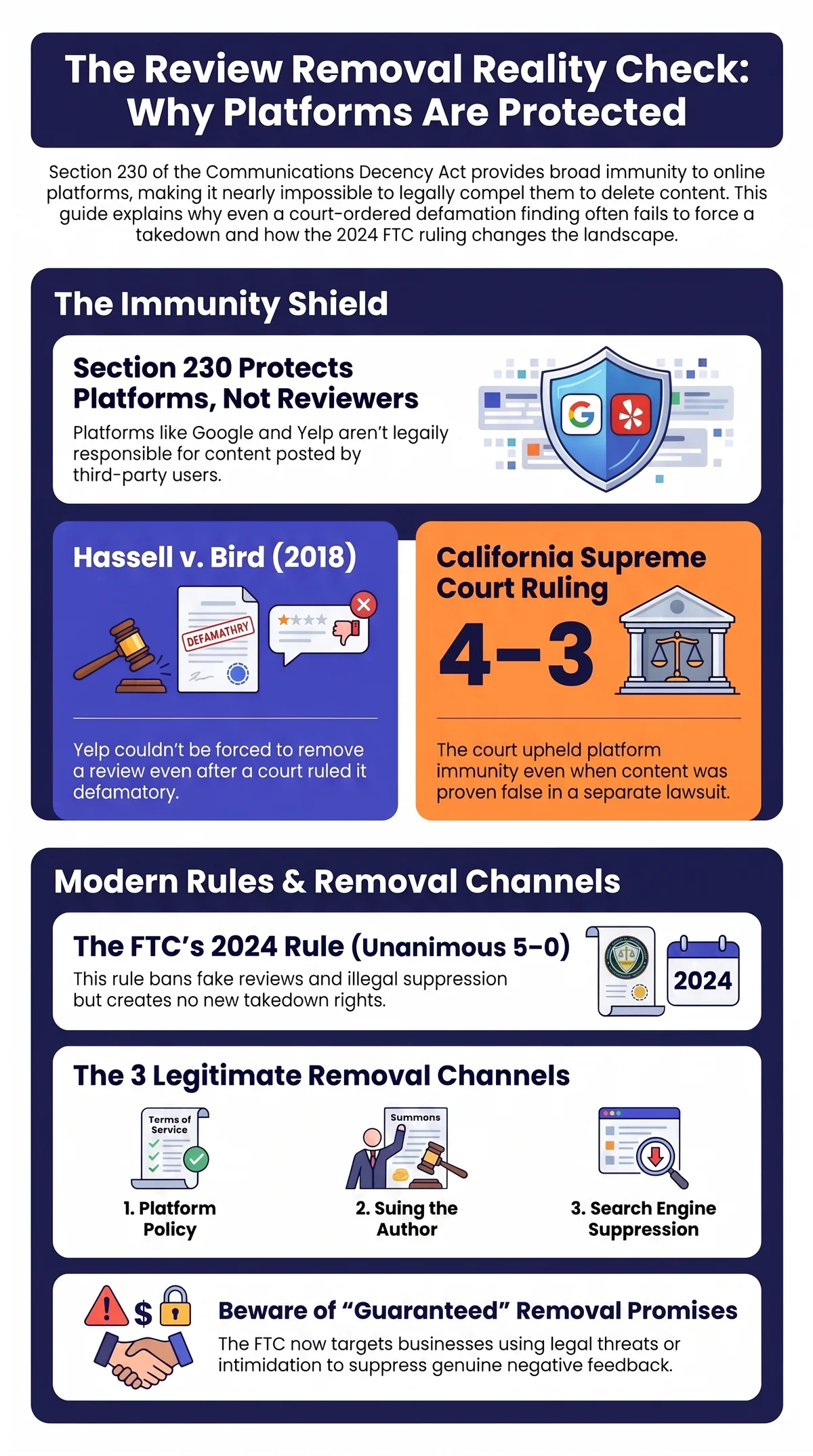
- Section 230 shields platforms, not reviewers — that’s why businesses usually can’t force a platform to remove even a false review.
- In Hassell v. Bird, courts ruled Yelp couldn’t be forced to remove a review already found defamatory — because Yelp itself was never sued.
- The FTC’s 2024 rule bans fake reviews and review-suppression through legal threats — not a new way to force takedowns.
- Legitimate removal runs through three channels: platform policy enforcement, a real defamation claim, or suppression when removal isn’t possible.
Why Section 230 Protects the Platform, Not the Reviewer
The reason a business usually can’t get a false review taken down by simply asking is a single sentence buried in a 1996 telecom law. Section 230 of the Communications Decency Act says that platforms like Yelp, Google, and Facebook are not treated as the “publisher or speaker” of content posted by someone else. In practice, that means the platform generally can’t be held legally responsible for a review it didn’t write — and a court generally can’t order the platform to remove it, even when the reviewer clearly broke the law by posting it.
Section 230 is the same reason a platform can choose not to verify who’s posting at all — and how much verification actually happens varies a lot by platform category; see our guide to that variation.
This is why “the review is false, so Google has to take it down” isn’t how the law actually works. The platform’s immunity doesn’t depend on whether the review is true.
It depends on who wrote it.
Hassell v. Bird: When a Court Already Agrees the Review Is False
The clearest illustration of how far this immunity goes is a 2018 California Supreme Court case, Hassell v. Bird.
An attorney, Dawn Hassell, sued a former client, Ava Bird, over a negative Yelp review — but she sued only Bird, not Yelp. Bird never showed up to court, so Hassell won by default, and the judge issued an order declaring the review defamatory and requiring its removal.
Hassell then took that order to Yelp and asked the platform to comply, even though Yelp had never been a party to the lawsuit. Yelp refused and fought the case all the way to California’s Supreme Court.
The court sided with Yelp, 4–3. The reasoning: forcing a platform to remove content based on a judgment against someone else — someone who never defended the case — is still a form of liability for third-party content, and Section 230 blocks that regardless of whether a court has already found the content unlawful.
In other words, a business can’t work around Section 230 by suing only the reviewer and then handing the resulting order to the platform.
(None of this is legal advice — if you’re weighing an actual defamation claim, talk to a lawyer who handles it in your state.)
What Section 230 Does Not Protect
Section 230 is broad, but it isn’t absolute. Two things it does not shield:
The reviewer themselves. Section 230 protects the platform, not the person who wrote the review.
A genuine defamation claim against the actual author — someone who published a false statement of fact, not just a harsh opinion — remains legally valid. It’s a slower, more expensive path than flagging a review, but it’s the one real legal lever a business has if the content is truly false and the harm is real.
The platform’s own policy enforcement. Section 230 stops courts from ordering a platform to remove content. It says nothing about the platform choosing to remove content on its own, under its own rules.
That’s why flagging a review for a genuine policy violation — a fake account, spam, a conflict-of-interest post from a non-customer — works through an entirely different channel than a legal takedown fight. It’s a private company enforcing its own terms of service, not a court compelling speech to come down.
Complaint-publishing sites lean on this same shield even more explicitly, often stating outright that they won’t remove a post without a court order — see our guide to the legal reality behind complaint-site removal.
The FTC’s 2024 Rule on Fake Reviews and Testimonials
In August 2024, the FTC finalized a rule on consumer reviews and testimonials, effective that October, passed by a unanimous 5–0 vote.
It’s worth understanding what it actually bans, because it’s easy to assume it hands businesses a new way to force removals. It doesn’t.
The rule prohibits businesses from: writing or buying fake reviews, including AI-generated ones; paying for reviews conditioned on a specific sentiment; using undisclosed “insider” reviews from employees or managers without disclosure; running fake “independent” review sites they secretly control; buying fake followers or engagement; and — most relevant here — suppressing genuine negative reviews through unfounded legal threats, intimidation, or false claims.
That last point cuts the other way from what most businesses expect. It’s not a tool for getting reviews removed — it’s a restriction on how a business is allowed to try.
A business that sends bogus legal threats to scare a reviewer into deleting an honest review, or falsely claims a review violates a law it doesn’t actually violate, is now the one taking on FTC risk.
How Review Removal Actually Works
Put together, legitimate review removal runs through three separate channels, not one:
Platform policy enforcement. Flagging a review that violates a platform’s own rules — spam, hate speech, a fake account, a conflict-of-interest post — is a private company enforcing its terms. Our review removal service works through this channel across every major platform.
In the cases I’ve handled, that’s the part clients feel most: the moderation process on the other end is often slow and inconsistent, even when the violation is clear-cut.
A real defamation claim against the author. If a review contains a false statement of fact you can document — not just an opinion you dislike — suing the person who wrote it, not the platform, remains a valid, if slower, path.
Courts have upheld this path repeatedly:
- In Blake v. Giustibelli (Fla. 4th DCA, 2016), a Florida court upheld $350,000 in punitive damages against a former client whose reviews accused her attorney of misrepresenting fees — a claim the reviewer admitted was false.
- In Summerfield Browne Ltd v Waymouth [2021] EWHC 85 (QB), a UK solicitors’ firm recovered £25,000 after a client’s Trustpilot review called it a “scam” — a factual accusation of crime, not opinion.
- In Musicki v de Tonnerre [2023] FCA 222, an Australian surgeon won a defamation judgment over a Google review posted under a fake patient name, after identifying the real author as a former medical student who had never been her patient.
Suppression, when removal genuinely isn’t possible. When a review is negative but not false, and doesn’t violate any platform policy, it usually isn’t going anywhere. At that point the realistic option is pushing it down in search results rather than fighting a legal battle you’re unlikely to win.
This is the situation Ripoff Report reviews tend to fall into — genuinely difficult to remove, which is exactly why the legal mechanism above matters: it’s not that nobody has tried, it’s that the platform is protected regardless.
If you’re dealing specifically with a Google review, we also cover the practical, platform-specific steps — flagging, escalation, and when to involve a lawyer — in our Google review removal walkthrough.
Red Flags: Tactics That Promise Guaranteed Removal
Given how narrow the actual legal options are, be skeptical of anyone who promises guaranteed review removal regardless of the situation. A service that claims it can force a platform to take down any review, or that leans on aggressive legal-sounding threats without an actual defamation case behind them, is either overselling what’s realistically achievable or edging toward the exact kind of suppression-by-intimidation the FTC’s 2024 rule now targets.
The honest version is less dramatic: some reviews come down because they violate platform policy, some come down because they’re genuinely defamatory and provably false, and the rest need to be outweighed and pushed down rather than erased.
Dealing with a specific platform? Get a free assessment and we’ll tell you what’s realistically removable in your situation.
Frequently asked questions
Can a business sue the person who wrote a fake review directly, even though it can't sue the platform?
Yes. Section 230 protects the platform, not the reviewer. A genuine defamation claim against the actual author, for a false statement of fact rather than a harsh opinion, remains legally valid, though it's a slower and more expensive path than flagging.
Did the Hassell v. Bird case actually decide whether the Yelp review itself was true or false?
No. The court never ruled on that. The case turned entirely on a procedural question — whether Yelp could be bound by a defamation judgment against the reviewer when Yelp itself was never sued. The court said no, 4-3, regardless of what the underlying judgment found.
Does the FTC's rule cover an employee posting a review of their own company without saying so?
Yes. The rule specifically bans using undisclosed "insider" reviews from employees or managers, along with running fake "independent" review sites a business secretly controls and buying fake followers or engagement.
Should I be suspicious of a company that promises guaranteed review removal?
Yes. Given how narrow the actual legal options are, a guaranteed-removal promise regardless of the situation is either overselling what's realistically achievable or edging toward the exact suppression-by-intimidation the FTC's 2024 rule now targets.
Start today
Not sure what to do next?
Tell us what's happening. We'll tell you honestly what your options are, confidentially.
Get my confidential assessment