The Gap Between a Sealed Record and What Google Still Shows
Drash Eldetron
Writes about digital privacy, reputation, and online presence.
September 3, 2026
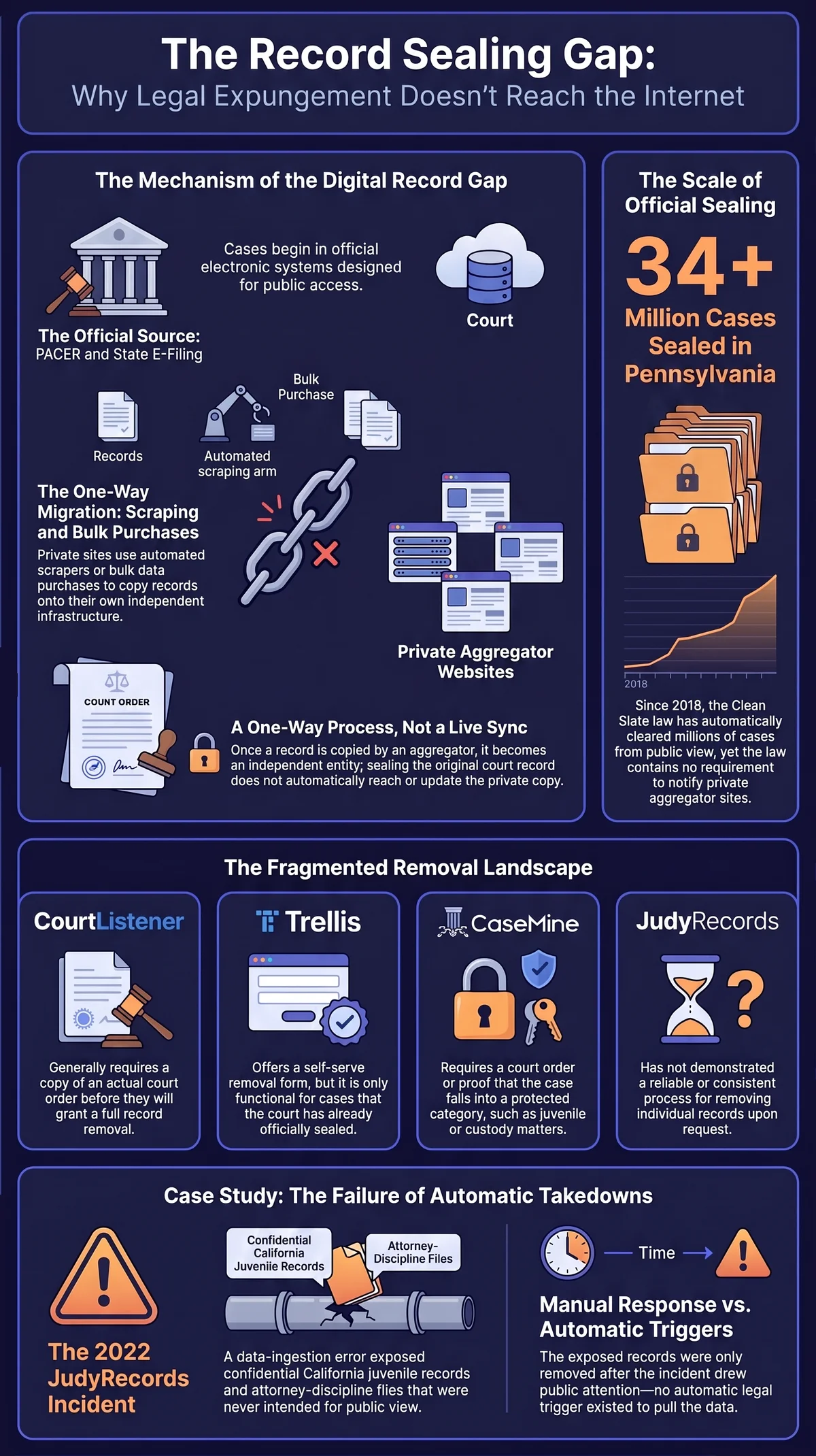
Pennsylvania’s Clean Slate law has automatically sealed over 34 million cases from public view since 2019. Its own announcement doesn’t say a single word about the private websites that already copied those records before they were sealed.
That's the actual gap this post is about: how a public record turns into a permanent search result, and why sealing or expunging the original almost never reaches those copies.
Quick overview
- Court records travel from PACER and state e-filing systems onto aggregator sites through scraping and crowdsourcing — it’s a one-way copy, not a live sync.
- Courts publish by default because openness is the presumption, though exactly which records stay non-public varies significantly by state.
- Expungement changes the official record, but neither Pennsylvania’s nor Michigan’s Clean Slate announcements even mention private aggregator sites.
- The real gap is structural: a sealed original doesn’t reach a copy someone already made and published independently.
How a Public Court Record Becomes a Searchable Website
A case gets filed, and the documents land in a court’s electronic filing system — PACER at the federal level, or a state’s own e-filing platform. That system exists to give the public access to court records, which is exactly what makes the next step possible: an aggregator site scrapes it, buys bulk data from it, or collects it from users who upload copies themselves.
CourtListener, run by the nonprofit Free Law Project, is unusually transparent about exactly how this works: it has purchased “thousands of items from PACER” directly, and its RECAP browser extension has more than 30,000 users who automatically donate a copy of every PACER document they view. Multiply that pattern across every aggregator on the market, official and volunteer-run alike, and a single filed case can end up copied onto several independent sites within days — none of which are obligated to keep checking the original for later changes.
A booking photo taken at arrest runs through a similar publish-first pipeline, though the legal issues that follow it diverge in an important way — see our guide to how the mugshot industry’s legal model actually works.
Why Courts Publish by Default, and Why the Rules Differ by State
Court openness isn’t an accident — it’s the starting assumption. Federal courts keep specific categories of documents non-public by rule: unexecuted warrants, presentence reports, juvenile records, and certain jury information, among others, while judges retain some discretion to seal additional material case by case.
States vary more than people expect. California operates on an explicit “presumption of openness” — court records are open unless there’s a specific overriding interest that justifies sealing them.
Missouri runs a different model entirely: cases assigned a “security level 5” can disappear from the public docket almost entirely, with little justification required beyond a court order. Neither approach is universal — the rule genuinely depends on which state’s courts you’re dealing with.
What Expunged or Sealed Legally Changes, and What It Doesn’t
Expungement and sealing are real legal actions with a real effect — just a narrower one than most people assume. As one criminal justice expert put it in a fact-check of New York’s Clean Slate law, “these records are not getting erased” outright; they typically remain accessible to law enforcement, for fingerprint-based background checks, and to agencies like the DMV, even after being sealed from general public view.
What’s more telling is what the official announcements don’t say. Pennsylvania’s own Unified Judicial System, describing the 34-million-case milestone above, never mentions private background-check companies or data aggregators at all.
Michigan’s Clean Slate law similarly limits access to set-aside convictions to “the governor, law enforcement, prosecutors and court” — again, no mention of third-party websites. That silence isn’t an oversight worth filling in with a guess; it’s the finding itself.
These laws were built to change who can see a record through official channels, not to reach into a private site’s already-published copy. The same principle shows up in news coverage of an arrest that’s later expunged: the coverage itself doesn’t become retroactively false just because the underlying record was cleared — see our guide to the legal reality behind news article removal for how courts have actually treated that question.
The Actual Gap: Why a Sealed Original Doesn’t Reach an Already-Made Copy
This is the mechanism at the center of the problem. Sealing or expunging a case is something that happens to the official record, at the source.
An aggregator site that already scraped, purchased, or received a crowdsourced copy of that record before it was sealed holds an independent copy on its own infrastructure — nothing about the sealing order reaches into that site’s database and updates it.
A real example already documented in our own research: in 2022, the aggregator site JudyRecords made confidential California State Bar attorney-discipline records and juvenile court records searchable, due to a gap in how it ingested its underlying data.
The records were pulled after the incident drew attention — not because a sealing order automatically triggered a takedown, but through the same kind of manual, after-the-fact response DIY requesters run into constantly. It’s a useful illustration precisely because even records that were never supposed to be public ended up on a third-party site through an independent pipeline error, with no automatic mechanism to catch or reverse it.
Why Different Aggregator Sites Handle This Differently
Because there’s no single legal switch that clears a record everywhere at once, each aggregator has built its own removal policy — and they genuinely differ.
- CourtListener generally requires an actual court order before it will remove a case in full.
- Trellis offers a self-serve removal form, but only for cases that have already been sealed by the court.
- CaseMine asks for either a court order or places a case in a specific protected category, like matrimonial or custody matters.
- JudyRecords, notably, hasn’t demonstrated a reliably consistent individual-removal process at all — which is exactly the kind of site where our help with JudyRecords listings tends to matter most.
What These Removal Requests Look Like From the Inside
The policies above are accurate, but the outcomes on the ground have more room in them than they suggest.
Without a sealing order, CourtListener and Trellis both formally decline to delete a case outright. That much matches their published policy.
But in cases I’ve brought to CourtListener, they’ve agreed to add a noindex tag instead — the document stays on their site, but it drops out of search results. Trellis has gone further in cases I’ve seen, redacting the person’s name and address from an otherwise-public record, again without a court order.
Once a case is actually sealed, submitting that order directly to the aggregator is not a formality. I’ve seen it carry real weight, even though the site holds its own independent copy from before the sealing.
The most common misunderstanding I run into with clients isn’t about any single site’s policy, though. It’s the assumption that a sealing or expungement order works like a switch.
Sign it, and the record is supposed to disappear from Google and every site that copied it, all at once. It doesn’t work that way — that’s the entire reason this gap exists in the first place.
What This Actually Means If Your Record Is Already Out There
Getting a case sealed or expunged is still worth doing for what it actually accomplishes — it changes who can see the official record through legitimate channels, and that matters for background checks that go through proper sources.
What it won’t do on its own is reach a copy an aggregator site already made before the sealing order existed. Those need to be dealt with directly, site by site, which is the part expungement was never designed to handle.
Not sure which aggregator sites actually have your record, or what each one’s removal process really requires? Get a free assessment and we’ll walk you through what’s realistic for your situation.
Frequently asked questions
Does a sealed court record still show up in background checks used for employment or licensing?
Sometimes, yes. Sealing generally limits general public access, but many states still allow access for fingerprint-based background checks and specific agencies like the DMV, even after a case is sealed.
Do all states handle court-record sealing the same way?
No. California operates on a "presumption of openness" that requires a specific overriding interest to seal a case, while Missouri allows cases assigned a "security level 5" to disappear from the public docket almost entirely with comparatively little justification required.
Has an aggregator site ever published court records that were never supposed to be public at all?
Yes. In 2022, JudyRecords made confidential California State Bar attorney-discipline records and juvenile court records searchable due to a gap in how it ingested data. The records were pulled after the incident drew attention — not because a sealing order automatically triggered a takedown.
Do court-record aggregator sites all use the same removal process?
No. CourtListener generally requires an actual court order. Trellis offers a self-serve removal form, but only for already-sealed cases. CaseMine asks for a court order or a specific protected case category. JudyRecords hasn't demonstrated a reliably consistent process at all.
Start today
Not sure what to do next?
Tell us what's happening. We'll tell you honestly what your options are, confidentially.
Get my confidential assessment