How Mugshot Sites Turn a Public Booking Photo Into a Business
Drash Eldetron
Writes about digital privacy, reputation, and online presence.
September 2, 2026
Publishing a booking photo is usually legal. Charging someone to take it back down is where the industry has run into real criminal exposure.
In 2018, California’s Attorney General charged the operators of one of the largest mugshot sites with extortion. In May 2025, three of them were sentenced. Here’s how the business actually works, and what changed.
Quick overview
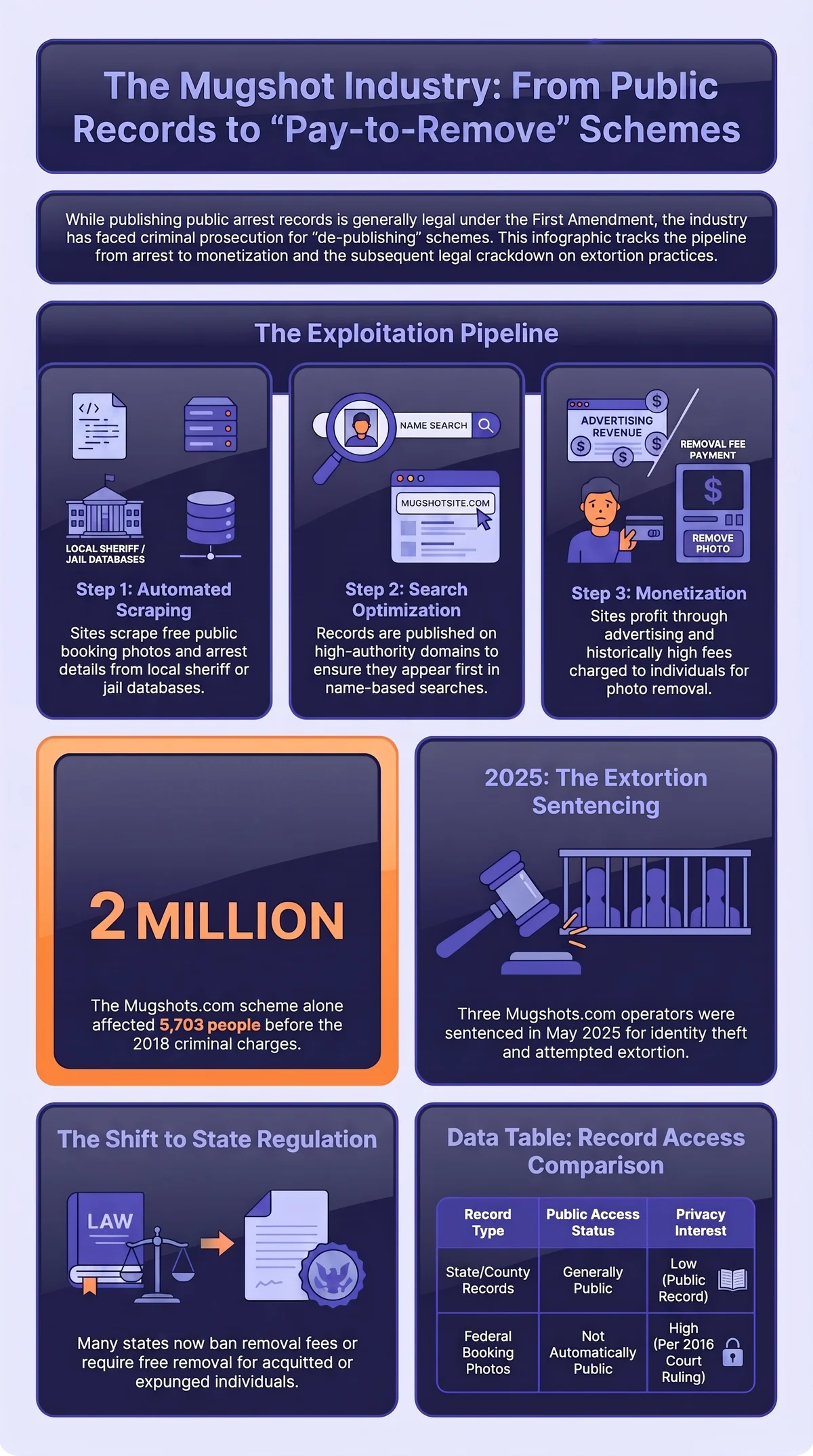
- Mugshot sites scrape free public arrest records, publish them optimized for name searches, then monetize through ads and removal fees.
- Publishing a booking photo is usually legal — it’s a public record. Charging to remove it is increasingly not.
- In 2018, California charged Mugshots.com’s operators with extortion; three were sentenced in May 2025 after pleading no contest.
- Several states now ban charging removal fees for public arrest records, though the specifics vary by state.
How the Mugshot Business Model Actually Works
The pipeline behind most mugshot sites is straightforward, and understanding it explains almost everything else in this post.
An arrest happens, and the booking photo and basic details become a public record held by the local jail or sheriff’s department.
A private site scrapes that record — for free, since it’s public — and republishes it on its own domain, optimized so the arrested person’s name is one of the first things that surfaces when someone searches it. The site earns money two ways: advertising and background-check referral traffic while the listing is up, and, on many of these sites historically, a “de-publishing” or “removal” fee charged directly to the person in the photo.
That second revenue stream — charging the person the record is about — is the part that has drawn the most legal scrutiny, for reasons that become clear once you separate what’s legal from what isn’t.
Why Publishing a Booking Photo Is Usually Legal
Arrest records, including booking photos, are public records in most jurisdictions. Republishing a public record is generally protected — the same basic principle that lets newspapers report on arrests before a conviction.
This is why simply asking a mugshot site to take a listing down because it’s embarrassing or because charges were later dropped often doesn’t succeed on its own: the site isn’t publishing anything it wasn’t legally allowed to publish in the first place. It’s the same “publicly available record” reasoning that lets a data broker resell your address and phone number — see our guide to that parallel legal gap — even though the two industries operate very differently day to day.
That’s also why the legal fight over this industry hasn’t centered on whether these sites can exist. It has centered on what they’re allowed to charge for.
The Case That Put the Industry on Notice
In May 2018, California’s Attorney General charged four individuals — Sahar Sarid, Kishore Vidya Bhavnanie, Thomas Keesee, and David Usdan — connected to Mugshots.com with extortion, money laundering, and identity theft. The allegation: the site published mugshots for free, then directed people to a separate “de-publishing” service where they paid to have their own listing removed.
The Attorney General’s office put a number on the scale of it: roughly $64,000 extracted from about 175 California residents, and an estimated $2 million nationally from around 5,703 people. Then-Attorney General Xavier Becerra didn’t mince words about the model: “This pay-for-removal scheme attempts to profit off of someone else’s humiliation.”
The case took years to resolve. In May 2025, Sarid, Bhavnanie, and Keesee were sentenced after pleading no contest to identity theft and attempted extortion, receiving probation and a combined $78,000 in restitution; Usdan had separately pleaded guilty to a lesser accessory charge back in 2022.
If you’re dealing with a Mugshots.com listing specifically, we walk through the current, non-pay-to-delete removal process. In my own casework, that holds up: I haven’t seen Mugshots.com charge for removal since the case, and that change didn’t come from goodwill — it followed the extortion charges above, plus a separate wave of class-action lawsuits over the same fee practice that kept legal pressure on the site.
States Are Starting to Draw a Legal Line
Since that case, a number of states have passed laws specifically targeting pay-for-removal mugshot practices — generally requiring free removal once charges are dropped, someone is acquitted, or a record is expunged, and in some cases banning removal fees for arrest-record photos outright.
The exact rules differ meaningfully by state: what counts as a qualifying record, how long a site has to comply, and what the penalty is for not complying all vary. This guide doesn’t list individual state statutes, since getting a specific state’s statute wrong is worse than not citing one.
The trend itself is the important part: what used to be an unregulated gray area is now something several state legislatures have decided needs an explicit legal boundary.
That legal shift is real, but it’s worth knowing what invoking it actually looks like from the inside. In the cases I’ve handled, citing one of these laws rarely produces an overnight takedown — the more common response is delay: a request for more documentation, use of the full compliance window the statute allows, or a form bounced back over some technical defect.
None of that is illegal. It’s just slower than “the law says so” suggests, and expecting an immediate result usually just adds frustration to an already frustrating situation.
Why the Federal Government Treats Its Own Booking Photos Differently
A separate, older case adds an interesting wrinkle, even though it doesn’t directly touch the commercial mugshot industry. In Detroit Free Press v. Department of Justice (2016), a federal appeals court ruled — reversing its own 20-year-old precedent — that federal booking photos held by agencies like the U.S. Marshals Service carry a real privacy interest under federal open-records law, and aren’t automatically public just because someone is criminally charged.
This case is easy to misread as bigger than it is. It applies specifically to federal FOIA requests aimed at federal agencies — it doesn’t reach the county and state jail records that actually feed the commercial mugshot sites covered above, and it doesn’t require any private website to take anything down.
It’s worth knowing mainly because it shows the federal government has, for its own records, moved toward more caution around booking-photo privacy — even while the state and county records the industry runs on remain broadly public.
What This Means If Your Mugshot Is Already Out There
If a booking photo of you is on one of these sites, the legal reality cuts both ways. The site publishing it likely isn’t breaking the law just by having it up — public records are, by design, publishable.
But if anyone is demanding money from you specifically to remove it, that request deserves real scrutiny, not automatic compliance: it’s the exact practice that has led to criminal charges, and several states now restrict or ban it outright.
One booking photo is also rarely confined to a single site — the same record tends to get scraped and republished by several aggregators independently, which is a separate mechanism worth understanding on its own; see our guide to how that syndication actually works. Our mugshot removal guide walks through the current process for the specific sites we cover, including which ones still require payment, which have moved away from it, and what your state-specific options actually look like — the same way we approach court records more broadly.
Not sure which site has your record, or what your options actually are? Get a free assessment and we’ll tell you what’s realistic.
Frequently asked questions
Does federal law require booking photos to be released the way state and county records are?
No. In Detroit Free Press v. Department of Justice (2016), a federal appeals court ruled that federal booking photos held by agencies like the U.S. Marshals Service carry a real privacy interest and aren't automatically public. That ruling applies only to federal FOIA requests, not the state and county records that actually feed commercial mugshot sites.
How much money did the Mugshots.com extortion scheme actually involve?
California's Attorney General put the scale at roughly $64,000 extracted from about 175 California residents, and an estimated $2 million nationally from around 5,703 people, before the case was charged in 2018.
Does Mugshots.com still charge a fee to remove a listing?
No — I haven't seen Mugshots.com charge for removal in any case I've handled. The shift away from fees followed the 2018 extortion charges and a separate wave of class-action lawsuits over the same practice, not goodwill.
Does having charges dropped or a record expunged automatically get a mugshot taken down?
Not automatically. Several states now require free removal once charges are dropped, someone is acquitted, or a record is expunged, but the site isn't obligated to check for that on its own — it generally requires the person to submit a request under that state's specific law.
Start today
Not sure what to do next?
Tell us what's happening. We'll tell you honestly what your options are, confidentially.
Get my confidential assessment