One Mugshot, Eight Websites: How Public Arrest Records Feed the Mugshot Industry
Drash Eldetron
Writes about digital privacy, reputation, and online presence.
September 3, 2026
Mugshot sites get their photos “in bulk through more efficient processes like scraping law enforcement websites and freedom of information requests,” and once one photo is online, other sites can copy and redistribute it independently — which is exactly why removing it from one site rarely means it’s gone from the rest.
This post covers how a single booking photo legally becomes public in the first place, why it tends to show up on several unrelated sites at once, and what the current patchwork of state laws actually requires those sites to do about it.
Quick overview
- Separate mugshot sites don’t trade data with each other — each one independently scrapes the same public booking-record feed.
- Whether a mugshot even counts as a public record varies by state — some exempt it, most don’t.
- At least five states now require free removal within a set window once a case ends favorably, each with different rules.
- Payment processors and Google both moved against pay-to-remove sites in 2013, but that didn’t stop the underlying scraping.
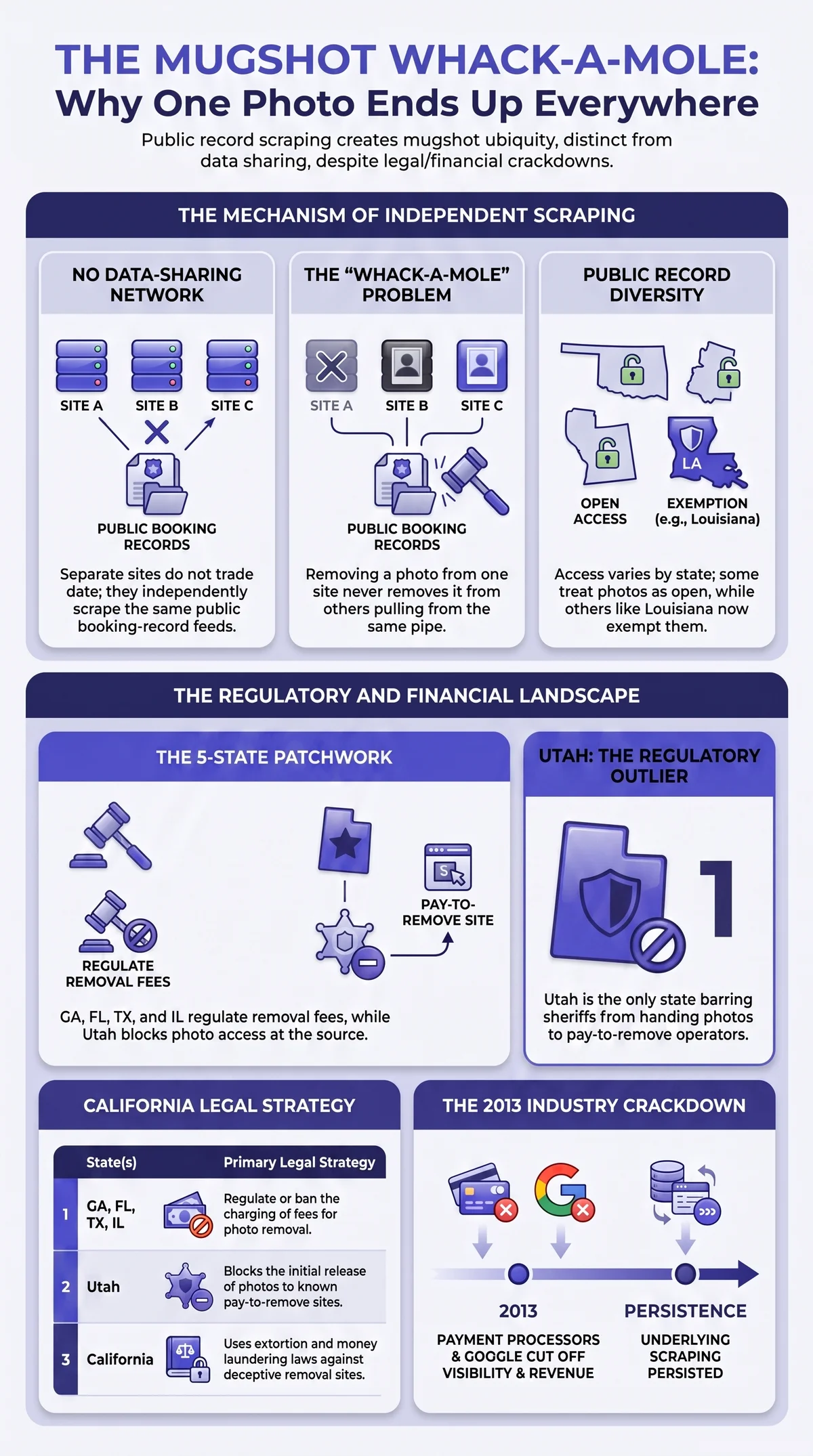
From County Jail to the Open Web
Whether a booking photo is a public record at all depends entirely on which state made the arrest — there’s no single national rule.
- Arizona treats mugshots as presumptively open records.
- Colorado classifies them as records of official action that generally have to be disclosed.
- Washington state exempts them from disclosure under its own court precedent.
- Louisiana passed a 2022 law that generally exempts mugshots from its Public Records Law, with only limited exceptions.
In most states without a specific exemption, the decision to release a booking photo is left to the discretion of the local department — and plenty of departments release proactively rather than waiting to be asked, with some local newsrooms describing a nightly feed of new booking photos straight from the sheriff’s office.
That baseline matters because it means the same channel a local reporter uses to get a booking photo is, in most states, open to anyone else who asks — including a mugshot website. For an overview of how that plays out across specific sites, see our mugshot removal guide.
The Real Mechanism: Independent Scrapers, Not a Data-Sharing Network
It’s tempting to assume the reason a photo shows up on five or six sites at once is that those sites are trading data behind the scenes. The actual mechanism is less coordinated than that, and in a way, worse: multiple sites independently scrape or file public-records requests against the same source — county jail rosters, state Department of Corrections lookups, sheriff press feeds — and each one publishes what it finds on its own.
Nothing about site A’s copy depends on site B; they just happen to be drawing from the same open pipe. Media-law analysis of the industry has described the result as a “whack-a-mole problem”: paying or petitioning one site to remove a photo does nothing to the copies that other, entirely unrelated sites already pulled from the same source before you ever started.
Data brokers run on a version of the same problem — clearing one listing doesn’t touch the others quietly pulling from the same refreshing public-records feed, which is why those listings tend to reappear on their own even after a successful removal.
Mugshot aggregator sites operate as separate businesses, each ingesting public arrest data and republishing it independently, with no need to talk to each other.
The State Law Patchwork
Because the underlying booking photo is a lawfully published public record in most states, the constitutional path to stopping publication outright is essentially closed — truthful information about a criminal matter, lawfully obtained from official records, has long been protected from government-imposed publication bans. What states have done instead, in a growing patchwork, is regulate the business of charging for removal, not the initial publication — the same publish-first, regulate-the-fee-later pattern covered in our guide to how the mugshot business model itself works.
Five states currently regulate this directly, each with its own trigger and penalty structure:
- Georgia requires a commercial website to remove a mugshot at no charge within 30 days once one of several conditions is met — acquittal, dismissal before indictment, an expired statute of limitations, or completion of a diversion program, among others — and treats a violation as a breach of the state’s Fair Business Practices Act.
- Florida requires a “criminal record publisher” to remove a booking photo within 10 calendar days of any written request, without charge, regardless of the case outcome, with civil penalties running $1,000 a day for a first violation and $5,000 a day if the photo goes back up afterward.
- Texas’s law — enacted as SB 1289 in 2013, not a more recent bill some sources misattribute — bars charging a fee to “remove, correct, or modify” inaccurate criminal-record information and sets statutory damages up to $500 per violation per day.
- Illinois makes it a Consumer Fraud Act violation to solicit a fee for removing or correcting criminal-record information, with a five-business-day window to fix confirmed errors.
- Utah takes the more unusual step of regulating the supply side directly: its law bars a sheriff’s office from handing over a booking photo to anyone who states it’s headed for a pay-to-remove website, with false statements on that point separately punishable as a crime.
When “Removal” Is Part of the Same Business
The clearest illustration of why “just pay to remove it” can be its own trap came out of Mugshots.com. In 2018, California’s Attorney General criminally charged four people connected to Mugshots.com and its companion site, Unpublisharrest.com, with extortion, money laundering, and identity theft — alleging the operation had extracted more than $2 million from thousands of people nationwide over three years.
A related federal class action had already alleged that Mugshots.com kept incomplete or inaccurate records — showing someone as still “on parole,” for instance — precisely so its own sister site could solicit removal fees running as high as $15,000, with no guarantee the photo would actually come down. The case finally resolved in 2025: three defendants pleaded no contest to identity theft and attempted extortion and were ordered to pay a combined $78,000 in restitution.
How Payment Processors and Google Responded
The industry did face real pressure once, just not from a lawsuit or a new statute. After a 2013 New York Times investigation into the pay-to-remove business model, Mastercard’s general counsel publicly called the practice “repugnant” and confirmed the company was cutting off the largest mugshot sites; PayPal, American Express, and Discover moved to sever their own merchant relationships within days, and Google separately changed its ranking algorithm so mugshot pages stopped surfacing as prominently in name searches.
It was a meaningful, fast response — but it targeted the payment and visibility side of the business, not the underlying scraping of public arrest data, which is exactly why sites publishing booking photos, including several still active today, kept operating afterward.
What This Means If Your Photo Is Already on Multiple Sites
Because each site is an independent scraper of the same public source, no single action clears a name from all of them at once. Realistically, that means treating each site as its own project: Arrests.org, BustedNewspaper.com, and every other site carrying your photo has to be dealt with on its own terms, using whatever leverage — a state statute, a formal dispute, direct negotiation — applies to that site.
In practice, citing the statute alone rarely moves a site. In the cases I’ve handled, the response is usually one of three things: silence, a request for documentation the law doesn’t require, or a reply only once the request arrives on an attorney’s letterhead.
That documentation hurdle is often less about compliance than a bet you’ll give up before assembling it. I’ve gotten a photo off every site carrying it, but never through one email — it takes legal status, search-side pressure, and a separate fight with each site.
One more pattern: a site rarely offers a direct “pay us to go faster” option — too close to the extortion the Mugshots.com/Unpublisharrest.com case was prosecuted for. More often it’s a nominally separate “reputation cleanup” brand, same people, positioned as the fix for a problem the first site created.
Trying to track down every site currently carrying your booking photo, or figure out which state law actually applies to your case? Get a free assessment and we’ll map out exactly what’s realistic to remove.
Frequently asked questions
If I get one mugshot site to remove my photo, will the others follow?
No. Each site independently scraped the same public record, so removing it from one doesn't touch the copies other, unrelated sites already published on their own.
Is it illegal for these sites to publish my booking photo in the first place?
Usually not, if the photo genuinely is a public record in that state — truthful publication of a lawfully obtained public record is constitutionally protected. What several states now regulate is charging a fee to remove it afterward.
Does paying a mugshot site's removal fee guarantee my photo comes down for good?
Not necessarily, and in at least one well-documented case it was closer to the opposite — the paid removal service and the site publishing the photo were run by the same operation.
Do any state laws stop a mugshot from being published in the first place, rather than just regulating removal fees?
Mostly no — most laws (Georgia, Florida, Texas, Illinois) regulate the fee charged for removal, not the initial publication, which is generally protected as a public record. Utah is the exception: it bars a sheriff's office from releasing a photo to anyone stating it's headed for a pay-to-remove site.
Start today
Not sure what to do next?
Tell us what's happening. We'll tell you honestly what your options are, confidentially.
Get my confidential assessment