Right to Be Forgotten vs. Defamation: What Actually Removes a News Article
Drash Eldetron
Writes about digital privacy, reputation, and online presence.
September 3, 2026
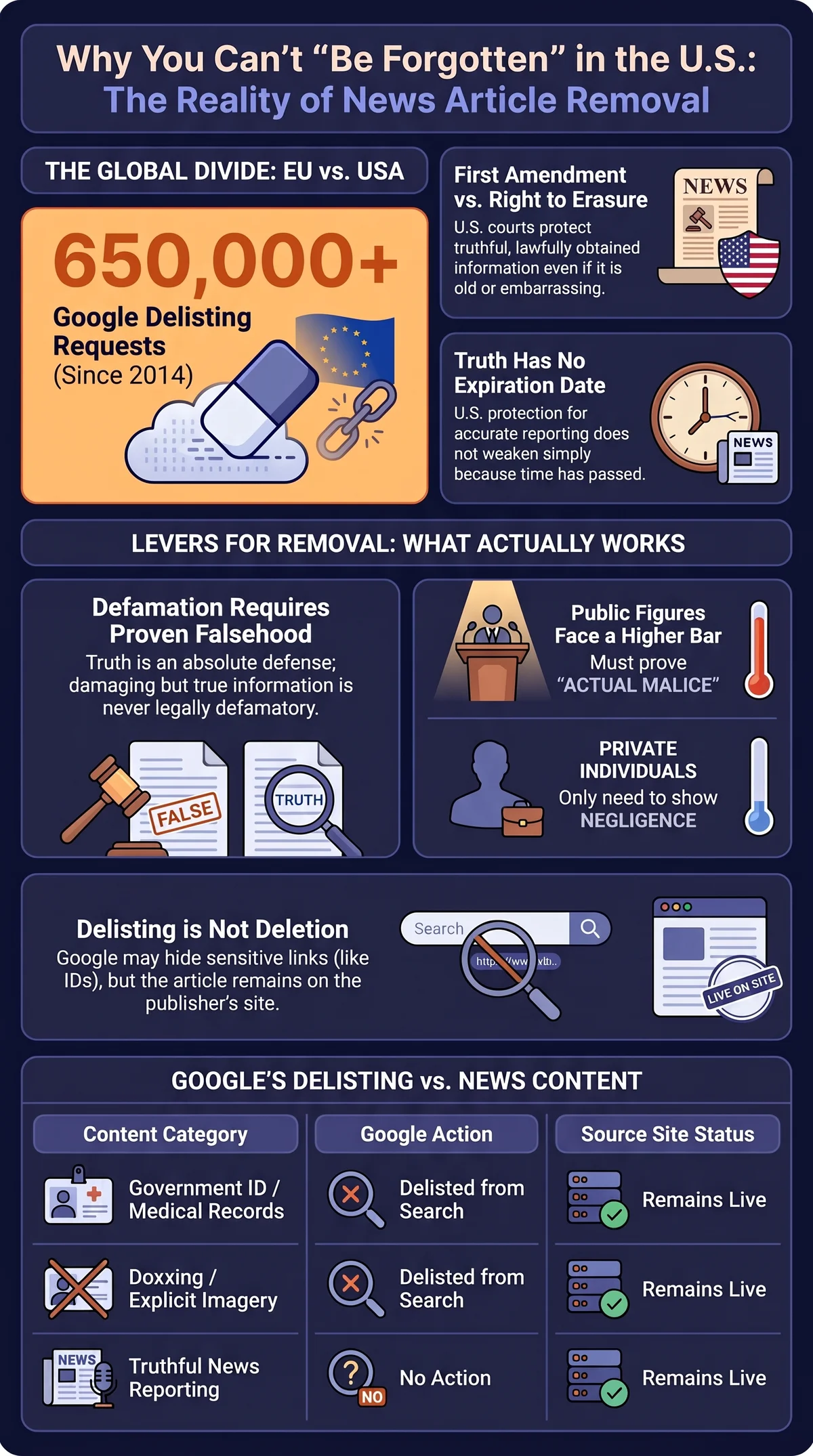
Since 2014, Google has fielded Europe’s “right to be forgotten” requests by the hundreds of thousands — over 650,000 of them by 2018 alone. Almost none of that machinery reaches someone living in the United States.
This post is about what actually exists instead: a narrower set of legal claims that can genuinely force a news article's removal, the ones that sound like they should work but don't, and the practical suppression that fills the gap when neither applies.
Quick overview
- The US has no GDPR-style right to be forgotten — the First Amendment protects truthful reporting even when it’s embarrassing.
- Defamation is the one claim that can force removal, but only for a false statement of fact — true information never qualifies, no matter how unflattering.
- Privacy torts exist too, but courts read “newsworthy” broadly, and some states barely recognize the claim at all.
- Google will delist specific sensitive categories from Search — the article usually stays live on the publisher’s own site.
Why the US Has No Right to Be Forgotten
Europe’s right to be forgotten started as a 2014 Court of Justice of the European Union ruling and is now written into GDPR as the “right to erasure.” It gives people a real, if imperfect, mechanism to ask Google to stop showing certain results for their name. It’s also explicitly geographic: Google states plainly that European delistings apply “for searches from an EU country,” and that it does not “apply these delistings to services for countries outside the European Union” — which includes the US, in full.
The reason isn’t an oversight — it’s the First Amendment doing exactly what it’s built to do. In Florida Star v. B.J.F. (1989), the Supreme Court held that once a newspaper “lawfully obtains truthful information about a matter of public significance,” the government can’t punish its publication absent a state interest “of the highest order.”
Cox Broadcasting Corp. v. Cohn (1975) set the same principle a decade earlier: truthful publication of information drawn from public records is constitutionally protected, even when it’s the kind of thing a person would clearly rather not see published. There’s no equivalent carve-out in US law that lets a private citizen simply ask for an article about them to disappear because enough time has passed.
Defamation: The Legal Lever That Actually Works
Defamation is the claim that can genuinely force a correction or removal — but it’s narrower than most expect. Under the standard elements (Cornell’s Legal Information Institute), a defamation claim requires a false statement of fact, published to a third party, that causes harm.
Every one of those words matters, but “false” is the one that ends most cases before they start: a statement that’s true, however unflattering, is never defamatory, full stop.
Who has to prove what also depends on who’s suing. New York Times Co. v. Sullivan (1964) set the bar for public officials sky-high — they need “actual malice,” meaning the publisher knew a statement was false or recklessly disregarded whether it was true.
Private individuals get an easier standard: under Gertz v. Robert Welch, Inc. (1972), a private person generally only needs to show the publisher was negligent — that it failed to verify the claim with reasonable care. For a private citizen, a genuinely false factual statement is real leverage.
In the cases I’ve handled, that leverage does its work before a lawsuit is ever filed. When the false statement is clear-cut, a demand letter laying it out plainly is often enough — the publisher corrects or pulls the piece rather than risk a suit it’s likely to lose, and it rarely goes further than that first letter.
If a specific article about you does contain a false statement, our guide to news article removal walks through what a defamation-based approach actually involves.
Privacy Torts, and Why “True but Embarrassing” Usually Isn’t Enough
Separate from defamation, some states recognize a “public disclosure of private facts” tort — publishing a private, non-newsworthy fact that would be highly offensive to a reasonable person.
The catch is in that last word: courts treat newsworthiness as, in the words of the Digital Media Law Project, “typically the dispositive element,” and they read it expansively. Information drawn from public records in particular carries what DMLP describes as “an absolute First Amendment privilege… regardless of how embarrassing.”
Sidis v. F-R Publishing Corp. (2d Cir. 1940) is the case most privacy-law casebooks reach for here: a former child prodigy who’d deliberately retreated into an ordinary, private life couldn’t stop a truthful magazine profile of who he’d become, with the court noting that “truthful comments upon dress, speech, habits, and the ordinary aspects of personality will usually not transgress this line.” This is exactly the gap outlets covering court filings sit in day to day — publications like Courthouse News Service and Law360 republish public court records as a routine part of legal journalism, and that coverage carries the same privilege. Availability of the privacy tort also varies sharply by state: New York, for instance, doesn’t recognize a general common-law privacy tort at all — only a narrow statutory right limited to using someone’s name or likeness for advertising, with its own newsworthiness exception built in.
The Narrow State Exceptions That Don’t Cover News Articles
A handful of state laws sound like they might apply here and don’t. California’s “Online Eraser Law” (Cal. Bus. & Prof. Code §§22580–22582), the closest thing the US has to a right-to-be-forgotten statute, only covers content a minor posted about themselves on a site they registered with — it has no reach over a third-party news article about that minor.
A broader “Right to Be Forgotten Act” was actually introduced in the New York State Assembly in 2017; it would have required removal of “inaccurate, irrelevant, inadequate or excessive” information within 30 days, and it died in committee without ever becoming law.
Expungement runs into the same wall, and it’s worth being precise about why. In Martin v. Hearst Corp. (2d Cir. 2015), a Connecticut arrest was later erased under the state’s Criminal Records Erasure Statute — but the court held that news coverage of the original arrest remained accurate and wasn’t retroactively defamatory, because “the statute does not and cannot undo historical facts or convert once-true facts into falsehoods.”
We’ve covered the mechanics of that same gap in more depth in our guide to why a sealed court record still shows up on Google — sealing changes who can see the official record through legitimate channels; it was never designed to reach into the coverage that already ran.
Retraction Requests and What Google Will Actually Remove
Most states have retraction statutes, but they’re procedural, not a removal right — they typically require a defamation plaintiff to request a correction before suing, and a timely retraction can cap the damages a publisher owes. What they don’t do is obligate a publisher to take a true, accurate story down.
Google’s own policy is narrower and more specific than people assume. Its “Remove my private info” process covers several defined sensitive categories, among others:
- Government ID and financial account numbers
- Medical records
- Doxxing content (personal information paired with threats, or aggregated without a legitimate purpose)
- Non-consensual explicit imagery
In practice, I’ve found Google reads these categories more narrowly than people expect. A submission that looks like a clean fit for “doxxing” or “no legitimate purpose” gets denied more often than it’s approved, so it’s worth going in with that expectation rather than treating the category list as a guarantee.
It’s worth being clear about what this actually does: it can pull a result out of Google Search, but the article itself generally stays live on the publisher’s own site and remains reachable directly or through other search engines. For that specific mechanism, see our guide to Google de-indexing.
A related but distinct problem shows up with mugshot publishing, where the same booking photo often gets independently republished by several sites at once rather than sitting behind one outlet’s archive — see our guide to how that syndication actually works.
When There’s No Legal Claim, Suppression Is the Realistic Path
If a story is true, doesn’t fall into one of Google’s sensitive categories, and the publisher has no interest in a voluntary update, there usually isn’t a legal lever left to pull.
What’s left is suppression — building up enough other legitimate, ranking content about you (a real professional site, active profiles, genuine press coverage) that a name search surfaces those results ahead of the one you’d rather not lead with. It’s slower than a takedown and it has to be maintained, since rankings drift over time, but it’s the honest, realistic answer when the article itself is both true and here to stay.
Trying to figure out whether a specific article qualifies for removal or delisting — or whether suppression is the more realistic path? Get a free assessment and we’ll walk through what’s actually achievable for your situation.
Frequently asked questions
Does requesting a correction or retraction get an article taken down?
Not directly. Most states have retraction statutes requiring a plaintiff to request a correction before suing, and a timely retraction can limit the damages a publisher owes — but no state law obligates a publisher to actually take a true, accurate story down.
Does any US state have its own right-to-be-forgotten law?
Only narrowly. California's Online Eraser Law is the closest thing the US has, and it only covers content a minor posted about themselves — not a third-party article. A broader New York bill modeled on the EU rule was introduced in 2017 but died in committee.
Is it harder to win a defamation claim if I'm a public figure rather than a private person?
Yes, meaningfully. Public officials and public figures must prove "actual malice" — that the publisher knew a statement was false or recklessly disregarded the truth. Private individuals only need to show negligence, a real, lower bar.
Does it matter that the article is old rather than recent?
Not legally. There's no US doctrine that makes a true, old article expire — First Amendment protection for accurate reporting doesn't weaken with time. What changes is search visibility, which is why suppression, not removal, is usually the realistic path for older coverage.
Start today
Not sure what to do next?
Tell us what's happening. We'll tell you honestly what your options are, confidentially.
Get my confidential assessment