Parametric Memory vs. Retrieval: Why AI Cannot Simply Forget You
Drash Eldetron
Writes about digital privacy, reputation, and online presence.
September 2, 2026
Most people assume an AI company could just delete what it knows about you if you asked nicely enough. OpenAI’s own response to a 2024 European privacy complaint says otherwise — it stated it does not seem to have any option to actually correct false information generated about a specific person.
That's not a policy choice. It's a consequence of how these models actually store information — and it's why fixing what an AI says about you needs a different playbook than fixing what Google shows.
Quick overview
- AI models store information two different ways: frozen training data baked into the model, and live web search results it summarizes on the spot.
- Correcting a website can change what a model says only when it’s pulling from live search — a correction can’t reach back and edit a model’s frozen training.
- When European regulators pushed OpenAI to fix a specific false claim, OpenAI said it could suppress the output, not correct the underlying error.
- OpenAI and Google both offer official correction request channels — useful, but neither guarantees a fix.
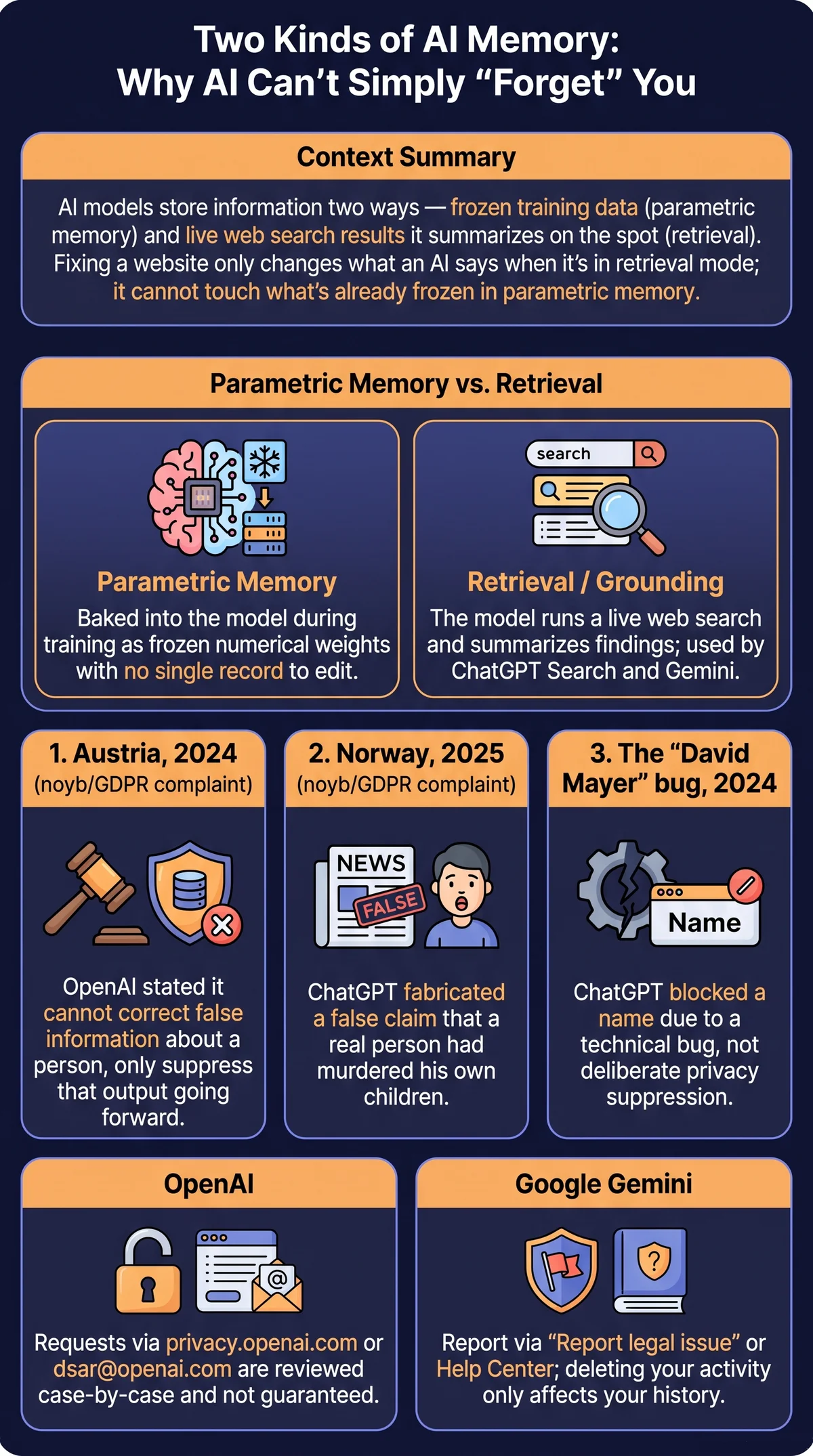
Two Completely Different Ways AI Remembers You
When people say an AI “knows” something about them, they’re usually describing one of two very different mechanisms.
Parametric memory is what a model learned during training — information compressed into billions of numerical weights, frozen the moment training ends.
It doesn’t update in real time, and it has no concept of a single record it could locate and edit. Asking a model to “forget” something in its parametric memory is a bit like asking someone to selectively un-learn one fact from years of reading, without touching anything else they know.
Retrieval, or grounding, is different: the model runs a live web search at the moment you ask a question, then summarizes what it finds, often with citations.
ChatGPT does this in its “Search” mode; Gemini does it through Google’s search grounding; Perplexity and Google’s AI Overviews are built around retrieval by default. This is the same mechanism behind how Google’s AI Overviews generate answers about a name — it’s pulling from indexed pages, not reciting something it memorized.
The distinction matters because the two respond to completely different fixes.
Why Fixing a Website Works for One and Not the Other
If a model is answering in retrieval mode — citing sources, browsing live — correcting or removing the underlying web page it’s pulling from can genuinely change its next answer. That’s the same lever behind conventional SEO and suppression work: control the sources, influence the summary.
If a model is answering from parametric memory, a website correction does nothing to it.
The false information isn’t “out there” being cited — it’s compressed into the model’s frozen weights from whenever it was trained, and it stays that way until the company releases a new version, on its own schedule, for its own reasons. Nobody outside the company can trigger that update on demand.
This is also why the same AI product can behave inconsistently on the exact same name: whether it happens to browse or answers from memory that day determines whether a source fix will do anything at all.
In the SERP suppression work I do, this shows up as a real practical headache, not a theoretical quirk. A source correction shows up in classic Google results on a fairly predictable timeline.
AI Overviews, ChatGPT Search, and Perplexity are not like that: the same fix can reflect almost immediately, lag well behind with no clear pattern, or produce a visibly different answer for the same name across different sessions with nothing else changed. I don’t treat an AI-generated answer as settled the way I’d treat a page-one Google ranking.
The David Mayer Glitch: What It Does and Does Not Prove
In 2024, ChatGPT was widely observed refusing to say the name “David Mayer” at all, going silent or erroring out mid-response. The initial theory online was that this was deliberate privacy-related suppression — maybe tied to a “right to be forgotten” request. OpenAI later explained it was actually a technical bug: an internal tool had mistakenly flagged the name, and the company fixed it.
It’s a useful example precisely because it shows how blurry this is from the outside. There’s no visible, external way to tell “the model genuinely doesn’t know this” apart from “someone quietly blocked this output” — because there’s no public interface for either one.
That opacity is part of why parametric memory is so hard to reason about, and why isolated glitches get read as conspiracies more often than they probably deserve.
What Happened When Regulators Tried to Force a Fix
Europe’s GDPR gives people a right to have inaccurate personal data about them corrected. Twice now, privacy group noyb has tested whether that right actually works against an AI model’s parametric memory — and both times, the answer has been complicated.
In a 2024 complaint in Austria, ChatGPT had generated an incorrect birth date for a public figure. OpenAI’s response, according to noyb, was that it does not seem to have any option to actually correct false information generated about a specific person — it can only suppress that output for that specific query going forward, not fix the underlying error.
In a 2025 complaint in Norway, ChatGPT had fabricated a claim that a real person, Arve Hjalmar Holmen, had murdered his own children — false in every respect. By the time the complaint was filed, a newer version of ChatGPT (with web search) no longer produced that specific claim, but noyb argued the underlying false association could still be embedded in the model’s training data, even if it wasn’t currently surfacing.
Worth being precise here: both of these are European complaints under EU law. GDPR’s right to correction assumes a controller can locate and fix one person’s data — parametric memory doesn’t work that way, since there’s no row-by-row record to edit.
This research didn’t turn up a confirmed identical case under U.S. privacy law, so treat the legal mechanism as EU-specific even though the underlying technical limitation is the same everywhere.
What OpenAI and Google Officially Let You Request
Both companies do offer real, named channels for this — worth using, just not worth over-relying on.
OpenAI’s privacy request process, filed at privacy.openai.com or by emailing [email protected], lets you ask for personal data to be corrected or removed from ChatGPT’s responses. OpenAI’s own policy notes these rights “are not absolute” and it “may decline a request” — and even when granted, it affects ChatGPT’s output, not the open web.
Google’s Gemini has a similar path: the in-app “Report legal issue” option under a response, or a request through the Gemini Apps Help Center, asks for inaccurate personal data in a response to be corrected. It’s reviewed case by case, not guaranteed, and — a common point of confusion — deleting your own Gemini Apps Activity only affects your conversation history, not what Gemini says about you when someone else asks.
From the removal requests I’ve filed with aggregator sites like PacerMonitor, I expected these AI-company channels to work roughly the same way: submit a form, wait, maybe follow up. They don’t.
An aggregator’s removal process is essentially an administrative queue. A DSAR-style request to OpenAI or a “report legal issue” flag to Google sits behind real legal obligations on one side and a model’s training and release schedule on the other — a different kind of process, not just a slower version of the same one.
Both are worth filing. Neither is a substitute for understanding which kind of memory you’re actually dealing with.
Why This Needs a Different Approach Than Classic SEO
Classic SEO suppression works on the retrieval layer: change what’s indexed, and you change what gets cited and summarized. That’s a real, proven lever, and it’s the backbone of how we approach AI reputation repair across every major model.
There’s no equivalent “de-index” button for a third party’s parametric memory. That’s not a gap in effort — OpenAI and Google both say, in their own words, that a guaranteed correction to the trained model isn’t something they can promise either.
The realistic strategy is layered: fix the sources that retrieval-mode answers actually cite, file the official request as a backup, and know the difference between the two well enough to set the right expectations from the start.
If you’re not sure what’s actually out there yet, our free reputation scan is a reasonable first look before deciding where to focus.
Want the fuller picture of everything that shapes what search engines and AI show about you? Read what actually makes up your digital footprint, or get a free assessment of your specific situation.
Frequently asked questions
Was the ChatGPT "David Mayer" name-blocking incident a right-to-be-forgotten case?
No. OpenAI later explained it was a technical bug where an internal tool had mistakenly flagged the name, not deliberate privacy-related suppression. It's a useful example of how hard it is to tell a genuine block from a limitation from the outside.
Does deleting my ChatGPT or Gemini conversation history change what the AI says about me to other people?
No. Deleting your own activity or chat history only affects your account's records — it doesn't touch the model's training data or what it tells someone else who asks about you.
Is there a US law equivalent to GDPR's right to correction for AI training data?
Not one confirmed here. The noyb cases testing this right were filed under EU law, and no equivalent case under US privacy law was found — treat the correction mechanism as EU-specific, even though the underlying technical limitation is the same everywhere.
Has an AI actually fabricated something false and specific about a real, named person?
Yes. In a 2025 Norwegian case, ChatGPT fabricated a claim that a real person had murdered his own children. A later version no longer produced that specific output, but privacy group noyb argued the false association could still be embedded in the model's training data.
Start today
Not sure what to do next?
Tell us what's happening. We'll tell you honestly what your options are, confidentially.
Get my confidential assessment