How to Shape What AI Says About You
Drash Eldetron
Writes about digital privacy, reputation, and online presence.
October 22, 2026
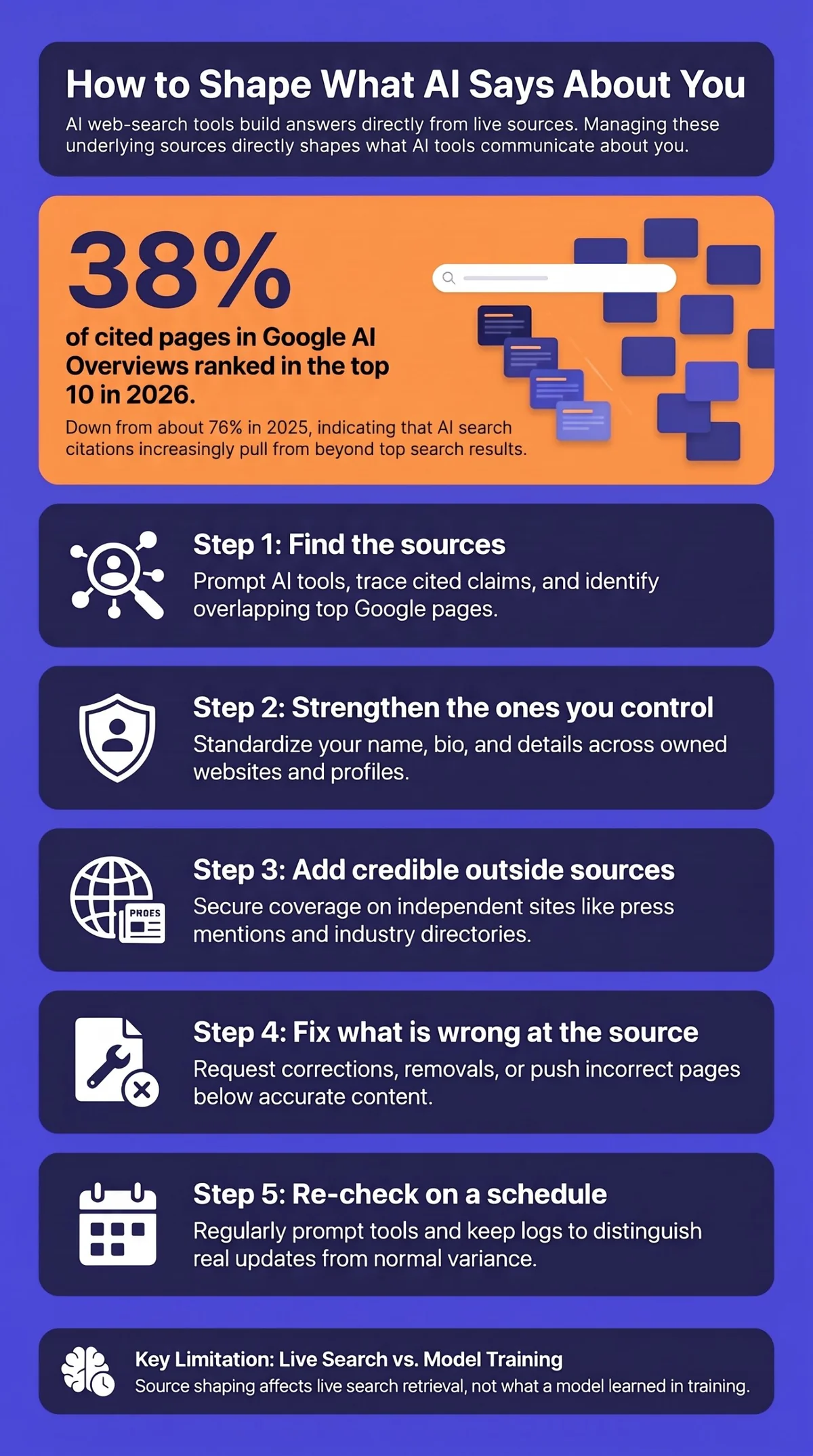
Most people assume an AI tool’s answer about them is fixed, something that simply happens to them. A lot of it isn’t — when a tool searches the web, it builds the answer from the pages it finds, and those pages come from well beyond the top of Google: in a 2026 analysis of Google AI Overviews, about 38% of cited pages ranked in the top 10 for the query, down from about 76% in 2025.
Here are five steps to influence which sources those tools find and what they say.
Quick overview
- AI tools that search the web build their answers from the pages they find, so the sources decide what they say.
- The five steps: find the sources, strengthen the ones you control, add credible outside ones, fix what is wrong at the source, and re-check on a schedule.
- Shaping works on live search, not on what a model learned in training.
Why the sources decide what AI says
When a tool answers a question about you, it draws on one of two things: what the model learned in training, or pages it searches for at that moment. Only the second can be influenced from outside, and the difference between the two decides how much of this guide applies.
In our work, the pages AI tools cite for a person or a business are most often the ones that rank on the first two pages of Google for that name. Rankings are not the whole picture, though, so the steps below cover both what ranks and what exists.
The 5 steps
1. Find out what AI says and where it comes from
Ask ChatGPT, Gemini, Perplexity and Google’s AI Overviews about your name or business, and write down every claim along with the sources each tool cites.
Then search the same name on Google and go through the first two pages of results. The pages that show up both in the AI answers’ sources and in those results are the ones doing the work.
Our AI reputation audit runs this across six tools and traces each claim to its likely source.
2. Strengthen the sources you control
Start with your own website and profiles, because you can change them directly. Use the same name, job title or business description everywhere: your About page, LinkedIn, and any directory listing you control.
Conflicting details give a tool more than one version to choose from. Outdated profiles are worth updating or closing.
3. Add credible sources you don’t control
If the only pages about you are your own, a tool has little to cross-check against. Accurate coverage on independent sites, such as press mentions, industry directories and interviews, gives it more reliable material.
This is the slow step, and it is the same work as reputation building in search.
4. Fix or push down what’s wrong at the source
If a wrong or outdated claim traces back to a specific page, deal with the page, not the AI answer. Ask the owner to correct it, request removal where the page qualifies, or push it below accurate content in search.
Google’s AI answers draw on indexed pages, as our AI Overviews guide explains, so a corrected page can change what they say.
5. Re-check on a schedule
AI answers are not settled the way a page-one ranking is. In our work, the same source fix can show up almost immediately, lag well behind, or give a different answer for the same name on a different day with nothing else changed.
Re-run the same questions at regular intervals and keep a log, so you can tell a real change from normal variation.
What shaping can’t change
Shaping works on tools that search the web. It can’t edit what a model learned in training, and no source change guarantees a specific answer.
Each tool also draws on its own mix of sources, so a fix that shows up in one may not show up in another.
When to get help
Steps 1 and 2 are easy to do on your own. Steps 3 to 5 take longer and depend on sources you don’t own, which is where help makes a difference.
Our AI reputation service audits what each tool says, corrects the sources behind it, and re-checks as the tools update.
Not sure what AI tools say about you right now? Get in touch and we’ll look at it with you.
Frequently asked questions
Can I stop AI tools from using pages about me?
Only partly. Some AI crawlers follow robots.txt rules, so you can restrict them on a site you own. That doesn't cover pages other people publish about you, and it doesn't undo anything a model has already learned, so the realistic limit is what you control.
Do I need a Wikipedia page for AI to describe me accurately?
No. Wikipedia has notability requirements and discourages people from writing their own page, so for most individuals and small businesses it isn't a realistic route. Consistent, accurate information on your own site and credible independent pages does most of the work.
Does this help if nothing negative about me is online?
Yes. When there's little to work from, the answer can be built from whatever happens to be most visible, such as an outdated profile or someone with a similar name. Having accurate sources in place first is easier than correcting a wrong answer later.
How long before an AI answer changes?
It varies by tool. One that searches the web can reflect a corrected source sooner than a model answering from its training, but no one controls those update cycles and no timeline is guaranteed. A source fix can also take a while to show up in answers.
Start today
Not sure what to do next?
Tell us what's happening. We'll tell you honestly what your options are, confidentially.
Get my confidential assessment